Sound is trembling air
When a bowl sings, its wall moves back and forth very quickly. It pushes the air, which pushes the neighbouring air… like a Mexican wave in a stadium. This pressure wave reaches the ear: that is sound.
Frequency (in hertz, Hz) is the number of back-and-forth movements per second: few of them, a low sound; many, a high sound. Amplitude is the strength of the wave: the sound is louder or softer.
- Sound travels at 343 m/s in air, 1,480 m/s in water and about 5,000 m/s in steel. In the vacuum of space: no sound at all, there is nothing to set trembling.
- The human ear hears from 20 Hz to 20,000 Hz. Below: infrasound (elephants use it to talk over long distances). Above: ultrasound (bats use it to see in the dark).
- The body is about 60% water: sound passes through it much better than through air. That is why we feel the vibrations of a gong or of a bowl placed on us.
Resonance: pushing at the right moment
On a swing, if you push at the right rhythm, each small push adds up and it goes very high. Every object has its favourite rhythm: its natural frequency. When a sound arrives at exactly that rhythm, the object starts to vibrate strongly: this is resonance.
A Tibetan bowl is a resonator: a small rubbing at the right rhythm is enough to make it sing for a long time. Two tuned bowls can even “answer” each other: if one sings, the other begins to vibrate on its own (sympathetic resonance, like the strings of a piano when you sing into it).
Sound travels through the body
Sound travels faster the stiffer the material: about 1,450 m/s in fat, 1,560 m/s in the brain, 1,580 m/s in blood, 1,590 m/s in muscle, 3,000 to 4,000 m/s in bone. Each part of the body also has its own measured natural frequencies: whole body seated 4 to 6 Hz, abdominal organs 4 to 8 Hz, spine 10 to 12 Hz, head 20 to 30 Hz, rib cage 50 to 100 Hz. That is why the drum and deep gongs are felt in the belly and chest, and singing in the head and sinuses.
Cymatics: seeing sound
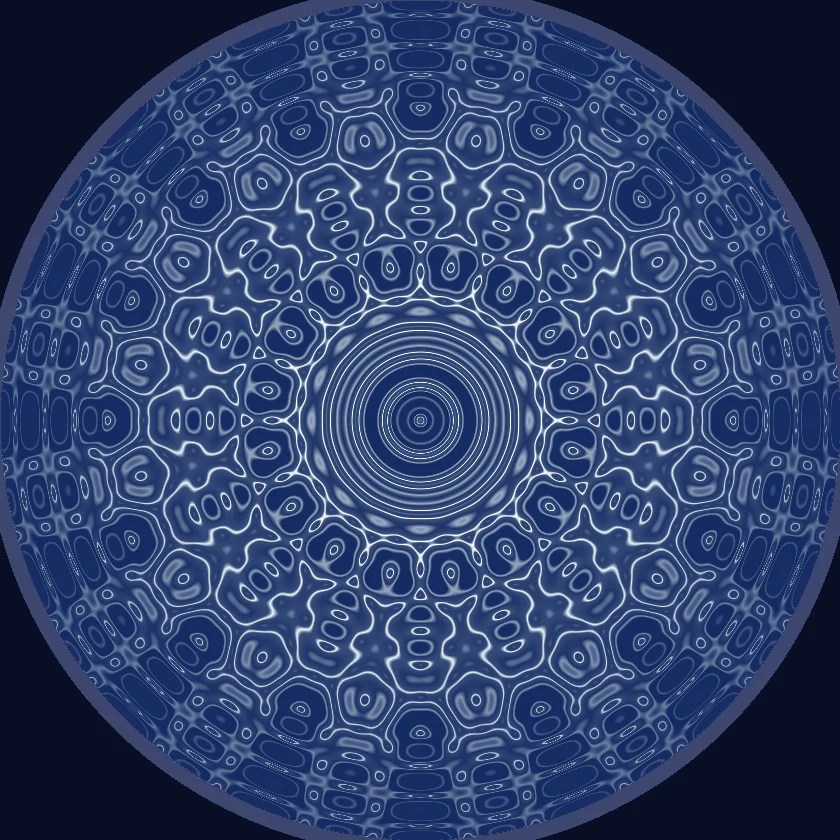
The word “cymatics” comes from the Greek kūma, the wave.
Choose a frequency to see the figure it draws on water (figure computed with Résonaé’s cymatics model):
77 Hz
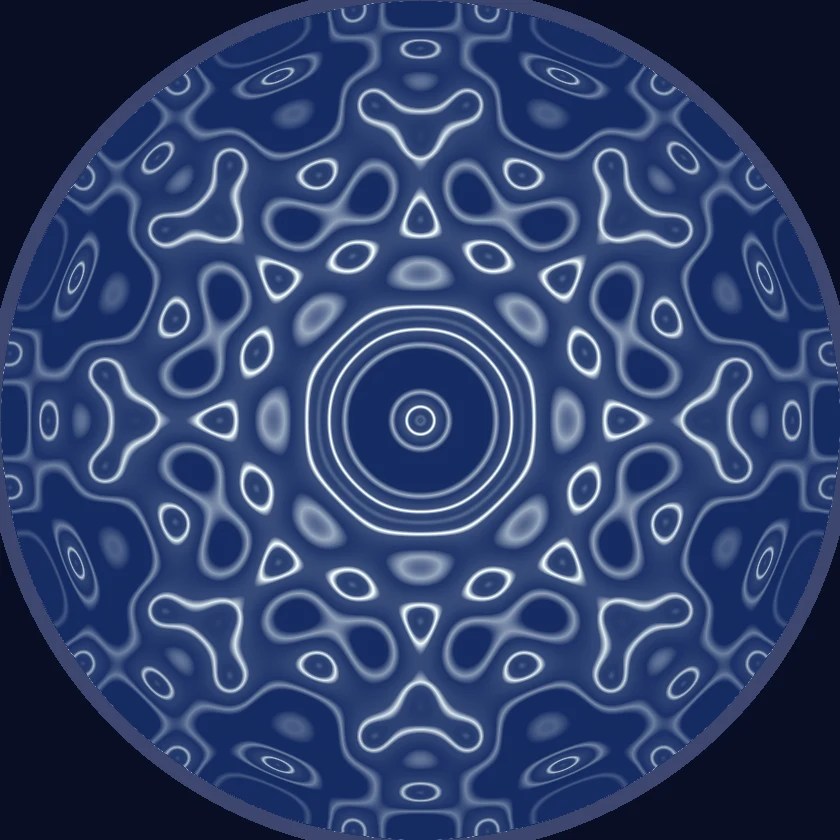
136.1 Hz (OM)
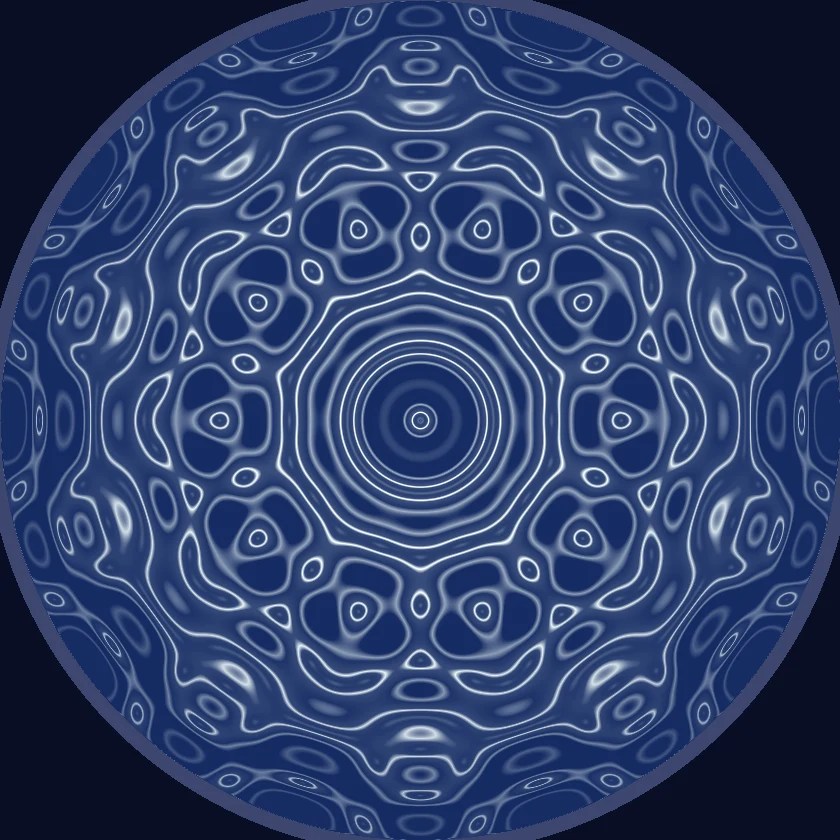
144 Hz
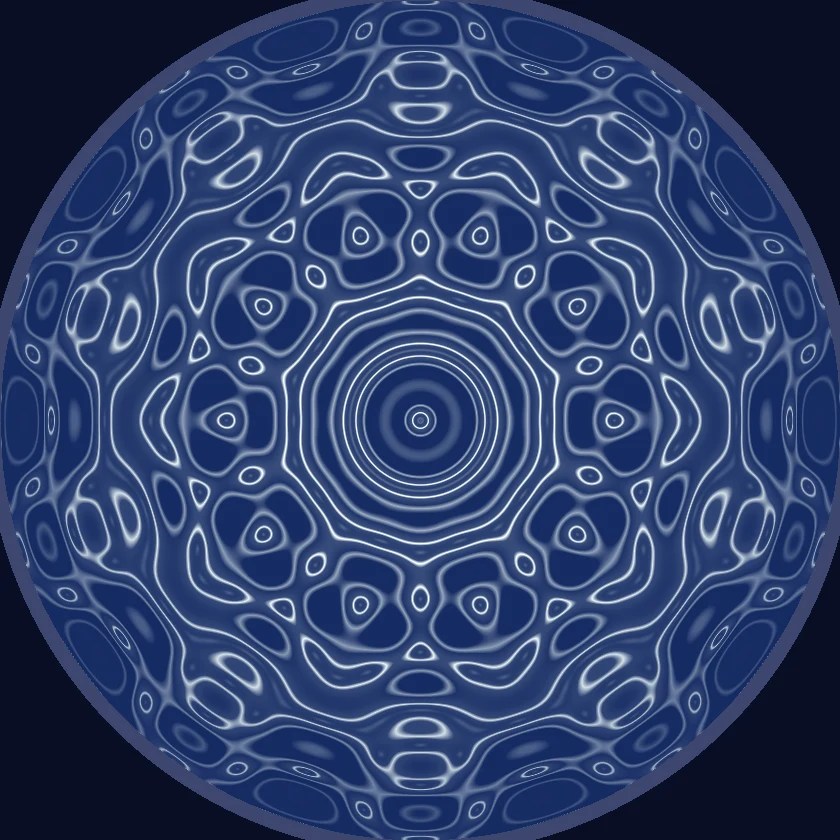
432 Hz
Ernst Chladni (1787)
In “Entdeckungen über die Theorie des Klanges”, the German physicist and musician Ernst Chladni shows for the first time that sound shapes matter. Drawing a violin bow along the edge of a metal plate covered with fine sand, he sees the grains leave the areas that vibrate most and gather on the still lines, in geometric figures of remarkable symmetry: the first visible image of sound.
Hans Jenny (1960s)
The Swiss doctor and researcher Hans Jenny takes up these experiments with electronic oscillators: steel plates, membranes, liquids and powders vibrate at precise frequencies. For more than ten years he photographs and films these phenomena and coins the word “cymatics”. Depending on the frequency and strength of the sound, matter organises itself into mandalas, cell-like forms and structures reminiscent of nature: flowers, shells, carapaces.
Today
Cymatics inspires acoustics, the visual arts and sound therapy. It reminds us that every sound carries a geometry within it.
Sources
- L. E. Kinsler, A. R. Frey et al., “Fundamentals of Acoustics”, Wiley, 4th ed., 2000 (speeds of sound); D. Purves et al., “Neuroscience”, Oxford University Press, 6th ed., 2018 (20 Hz – 20,000 Hz).
- K. B. Payne, W. R. Langbauer, E. M. Thomas, “Infrasonic calls of the Asian elephant”, Behavioral Ecology and Sociobiology, 18, 1986; D. R. Griffin, “Listening in the Dark”, Yale University Press, 1958.
- Institute of Medicine, “Dietary Reference Intakes for Water…”, 2005, table 4-1 (60% water on average in adults).
- R. P. Feynman, R. B. Leighton, M. Sands, “The Feynman Lectures on Physics”, vol. I, chapter 23 “Resonance”, 1963.
- F. A. Duck, “Physical Properties of Tissue”, 1990, and the IT’IS database (speeds of sound in tissues); Rasmussen, 1983 (natural frequencies of the body).
- E. F. F. Chladni, “Entdeckungen über die Theorie des Klanges”, Leipzig, 1787; H. Jenny, “Kymatik”, 1967.

